Models: Studio Days 2026

March 6 and 7, 2026
University of Southern California
Alexander Robinson (USC) and Julien Emile-Geay (USC)
What makes a model a tool or object of ethnographic research? What can models help envision or prevent from seeing? What are the limitations and possibilities of models in ethnographic projects? Studio Days was a space for researchers to explore these questions, working both collectively and individually on their own projects. This was a two-part event (February 6th and March 6th-7th) facilitated by Dr. Andrea Ballestero, bringing together 10 participants including PhD students, postdoctoral students, and senior researchers.
Models have been theorized as operating pragmatically, being more or less useful rather than more or less true (Sismondo, 1999). They help create objects of attention through conceptual, quantitative and material means intended to create resonance between our knowledge and the conditions of the world (Ballestero, 2023). As parts of larger chains of reference, models can create an object which is subject to thought but demonstrates the uncertainties and complexities of reality (Gårding, 1999; Petersen, 2023). There are conceptual models, numeric models, and physical models, all of which are practical accomplishments with material groundings which facilitate the production of experimental results (Parker, 2009). Studio Days created the conditions to inquire into their expression as computational, legal, regulatory, health models and more. Beyond theorizing what models are, the Studio Days focused on ethnographic projects already utilizing models as tools and objects of research in areas such as public health, finance, land use planning and housing.
On the first part of Studio Days, on February 6th, we joined a collaborative session with Dr. Martina Klausner and students at Frankfurt University to learn about their work on biodiversity modeling in collaboration with the Center for Critical Computation.
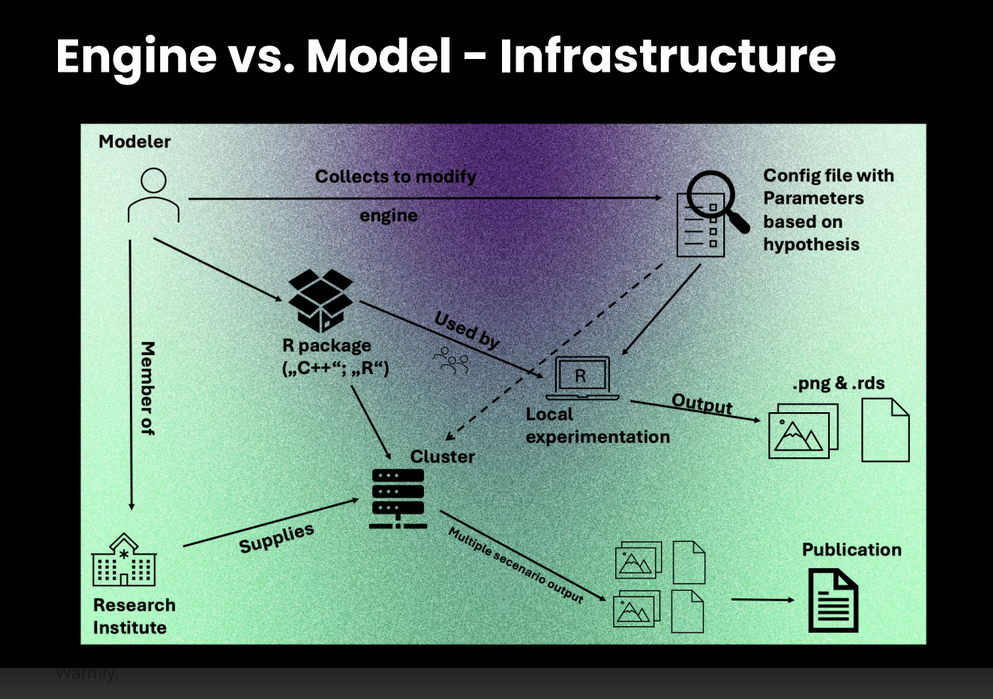
Source: Modeling (With) The World (unpublished). By: Ece Erdemir, Lieur Walker, Muriel Lippert, Maria Cieszyńska, Jonathan Rutschinski. Frankfurt University.
The Frankfurt Team worked with Professor Oskar Hagen asking ethnographic questions of him and his model “gen3sis,” a computer model of biodiversity. The team shared their process of collaboratively engaging with a highly complex research object and how they developed questions that opened up ethnographic view points. We also heard from Prof. Hagen’s take on ethnography and what it can reveal to a modeler like himself.
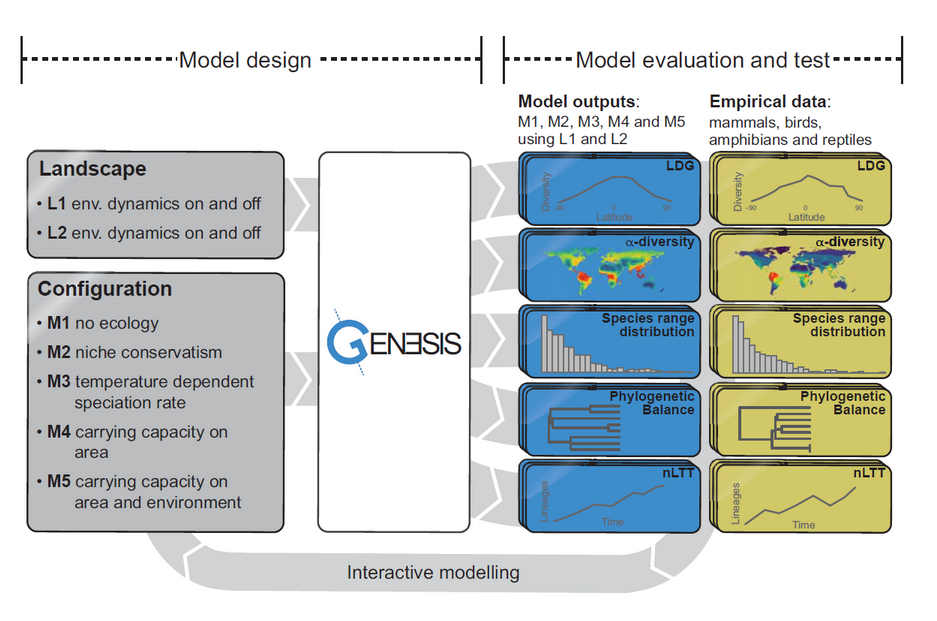
Source: Hagen O, Fluck B, Fopp F, Cabral JS, Hartig F, Pontarp M, et al. (2021) gen3sis: A general engine for eco-evolutionary simulations of the processes that shape Earth’s biodiversity. PLoS Biol 19(7): e3001340. https://doi.org/10.1371/journal.pbio.3001340
The second part, March 6th-7th, opened with keynotes by Alexander Robinson (Departments of Architecture and Spatial Sciences, USC) and Julien Emile-Geay (Department of Earth Sciences, USC). Dr. Emile-Geay introduced numerical and climate models, examining their scientific histories and trajectories, the assumptions they are based on, and how they circulate on a global scale, as climate models often do. This was a small sample of the work Dr. Emile-Geay and his team do in their paleoclimate lab. His work is motivated by the question of how we can make the best inferences possible out of data.
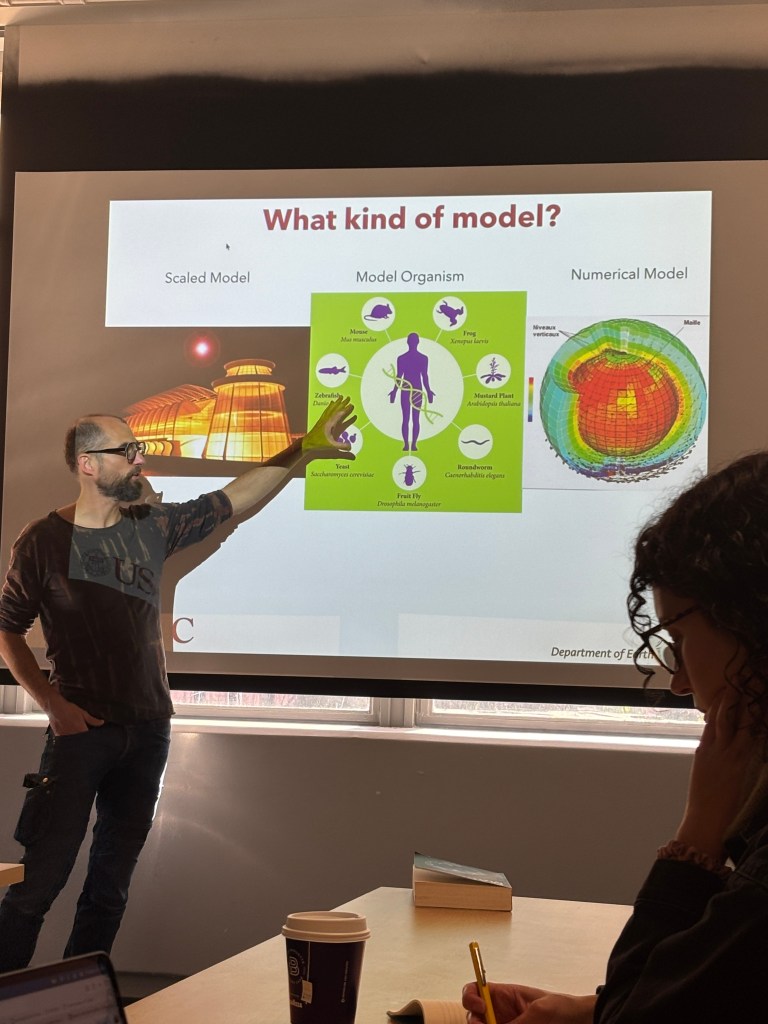
Dr. Robinson’s talk showed how different modeling tools are combined to bring “humanness” into the design of infrastructure projects, where infrastructure is understood as a form of landscape. He presented two cases, the Owens Lake and the LA River, in which physical and digital modeling such as sand modeling systems and augmented reality systems allow community members and designers to encounter technical models as interfaces to impress human and landscape features into each other.

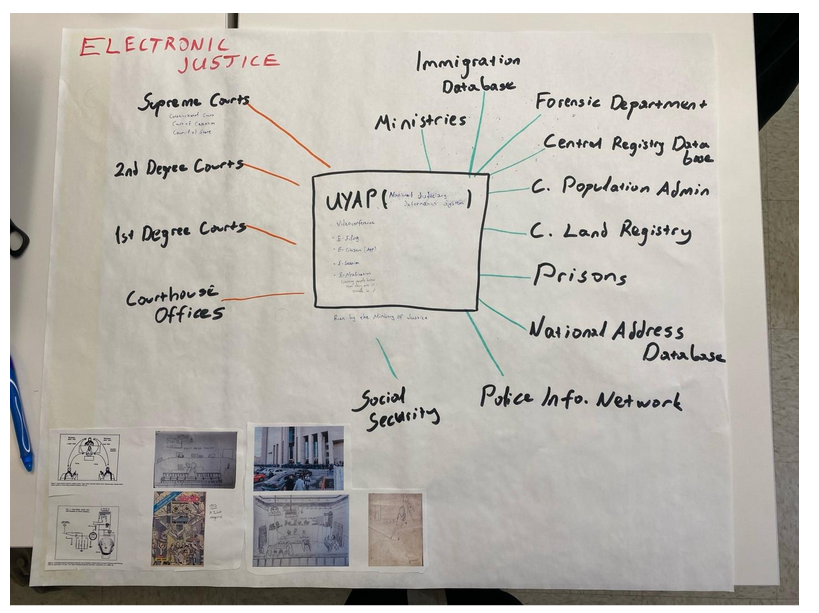
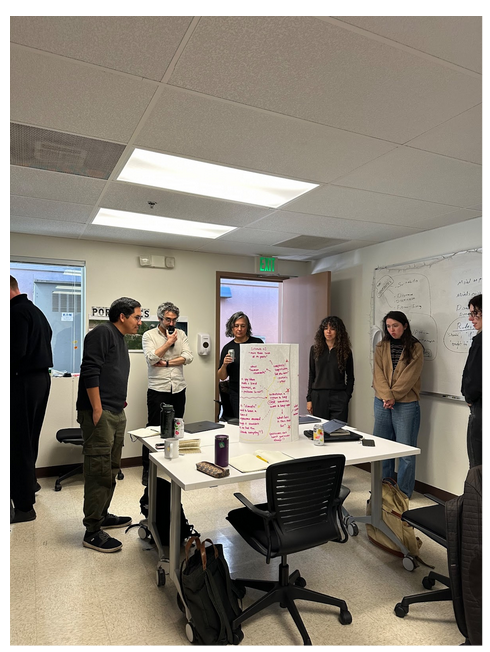
After the morning keynotes, participants worked over two full-days—both in groups and individually—to distill models as ethnographic objects and partners. They translated their original submissions responding to the CFP into multimodal objects (some of which can be found below) and also reworked their textual engagements with ethnographic models in their individual projects. These were not merely replications but reinventions reflecting how a model can guide anthropological fieldwork and analysis. The final product of the Studio Days will be a protocol on how to engage ethnographically with models.

Participants’ Ethnographic Models
Bouchra Tafrata
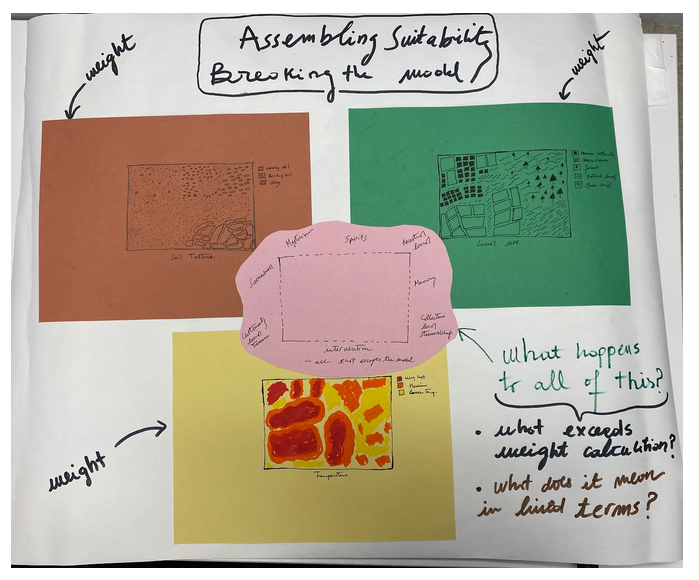
Leanne Loo

Onur Arslan
Emma Jahoda-Brown, Leanne Loo, Katie Ulrich (cylindrical model)

References
Ballestero, Andrea. “Casual Planetarities: Choreographies, Resonance, and the Geologic Presence of People and Aquifers,” Environmental Humanities 15, no. 3 (2023): 266-83.
Gårding, Lars. “Models in Science and Otherwise,” Proceedings of the American Philosophical Society 143, no. 1 (1999): 3–11.
Parker, Wendy S. “Does Matter Really Matter? Computer Simulations, Experiments, and Materiality,” Synthese 169, no. 3 (2009): 483–496.
Petersen, Arthur C. “Models,” in Climate, God and Uncertainty: A Transcendental Naturalistic Approach Beyond Bruno Latour. University College London Press, 2023.
Sismondo, Sergio. “Models, Simulations, and Their Objects”. Science in Context 12 no. 2 (1999): 247–260.
