Roundtable: Shifting Matter(s), Slippery Maps 2024

March 4, 2024, 3pm PT
University of Southern California THH 309K and Zoom
Shannon Mattern (University of Pennsylvania) and Annette Kim (USC)
We enjoyed a lovely conversation with Dr. Annette Kim and Dr. Shannon Mattern on this year’s Ethnographic Salon theme, shifting matter(s), slippery maps. This roundtable followed our student workshop earlier in the day. Watch the recorded event below.
Mapping is a technical, political, and imaginative practice. Extant critiques of the mapping imagination have noted the move from imperial forms of seeing to counter-mapping efforts to present the world anew (Crampton 2010, Mattern 2013). The latter follows an ethics and ontological politics that subverts the exclusionary, extractive, and unimaginative forms of map-making that feed into dominant economic, racial, and political regimes (Mattern 2015, Kim 2015, Peluso 1995, Morris and Voyce 2015). Building on this line of critique and the new horizons of map-making it inspires (e.g. Bond 2017, Fujikane 2021, Loften and Vaughan-Lee 2019, Chari 2017, and many more), we are interested in dwelling more slowly in the problem of form and shape shifting. How do we map phenomena, beings, and places that are in constant transformation? What aesthetic and epistemological questions might be generated by a mapping practice that is committed to changing form? And what kind of collective analytic resources might mapping in a studio context produce?
This year’s Ethnographic Salon and roundtable were organized in coordination with the Center for Science, Technology and Public Life and form part of the Studio’s events in the context of the EMERGE collective.
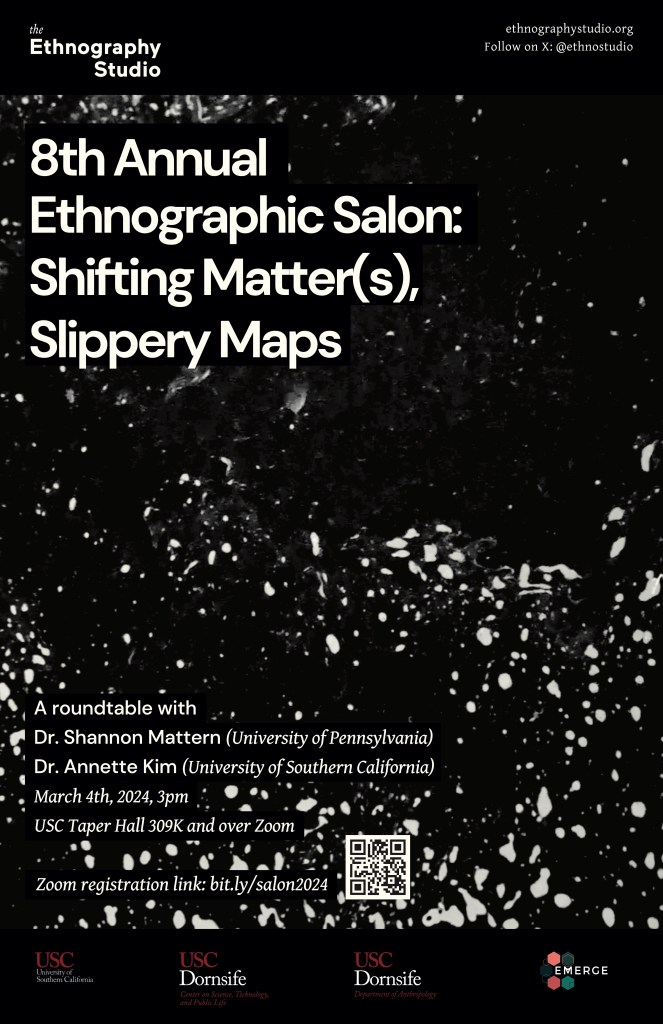
Thank you also to Taller Agosto for their work on our beautiful 2024 Salon posters. They explained the process behind the images (which are actually video stills) featured in the posters:
“Después de casi un mes sin lluvia, la semana pasada volvieron los aguaceros a Bogotá. Pensando en las superficies difíciles de agarrar porque cambian, encontramos en los charcos de la calle formas que parecían islas flotantes de jabón y grasa. Ese día el agua nos dio muchísima alegría porque apagó los incendios que crecían descontrolados en los cerros que rodean la ciudad. El primer día que llovió fuimos muy felices, ahora no tanto porque los aguaceros son muy fuertes y duran horas. Es probable que lleguen las inundaciones.“
References
Sarah Bond, “How Is Digital Mapping Changing the Way We Visualize Racism and Segregation?” Forbes (October 20, 2017)
Sunitha Chari, “Mapping Back: A Workshop on Counter Mapping Resource Conflicts on Indigenous Homelands,” Transformations to Sustainability (December 4, 2017).
Jeremy Crampton, “What Is Critique?” In Mapping: A Critical Introduction to Cartography and GIS (Wiley-Blackwell, 2010): 13-21.
Candace Fujikane, “Introduction: Abundant Cartographies for a Planetary Future” in Mapping Abundance for a Planetary Future: Kanaka Maoli and Critical Settler Cartographies in Hawai’i (Duke University Press, 2021): 1-30.
Annette Kim, Sidewalk City: Remapping Public Space in Ho Chi Minh City. The University of Chicago Press (2015)
Adam Loften and Emmanuel Vaughan-Lee, “Counter Mapping,” emergence magazine (December 2019).
Shannon Mattern, “Gaps in the Map,” Words In Space (September 15, 2015)
Shannon Mattern, “Critiquing Maps II,” Words in Space (September 5, 2013).
Dee Morris & Stephen Voyce, “William Bunge, the DGEI, & Radical Cartography,” Jacket 2 (March 20, 2015)
Nancy Lee Peluso, “Whose Woods Are These? Counter-Mapping Forest Territories in Kalimantan, Indonesia,” Antipode 27:4 (1995): 383-406
