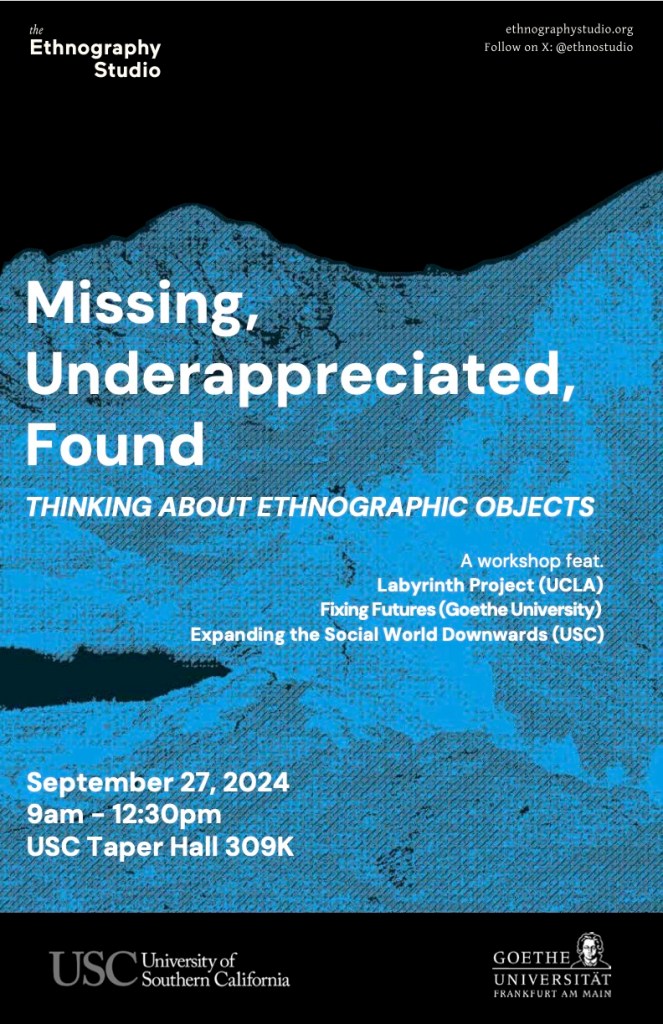
Missing, Underappreciated, Found 2024
September 27, 2024
USC THH 309K
Colleagues from Goethe University Frankfurt and UCLA
How do we think with missing, underappreciated, and found ethnographic objects? What role do transitional knowledge devices play in conjuring ethnographic insights?
This workshop examined the transitional devices that ethnographers encounter or produce in their work to conjure their research projects. The aim was to dwell in the affordances of these ethnographic tools (satellite maps, databases, quantitative models, etc.) as they sit in the midst of established forms of ethnographic fieldwork, i.e. participant observation and interviews.
At a time when ethnographers increasingly address multi-scalar data and phenomena, multi-species concerns, and geological questions, ethnographic experiments mushroom. These experiments often have at their core transitional devices that focus our attention to open new lines of inquiry, although they can also limit the creative potential of ethnographic work. During the workshop we thought alongside these devices, highlighting the pragmatic implications of their making and use as well as their connection to the research questions that collective projects pursue. Ultimately, rather than take these devices for granted as aesthetic or political objects, the question we explored was what specific uses they are put to in concrete research projects.
At the workshop three research teams presented work in progress: Labyrinth (UCLA), Fixing Futures (Goethe University), and Expanding the Social World Downwards (USC).
Workshop program
9.05 Welcome by Martina and Andrea
9.15 Introductions
9.45-11.00 Works in Progress Panel: Thinking with Transitional Objects – Labyrinth: More-than-human Sounds, Sensations, and Affects (UCLA); Tracing Data Politics: Data Visualizations (Goethe); Expanding Downwards: Maps (USC)
11.00-11.15 Break
11.15-12.15 Discussants: Kim Fortun (UCI) & Peter Redfield (USC)
Q&A
12.30-2.00 Lunch at University Club
2.00 PhD Student Coffee Hour at Annenberg Café
3.00 Visit “Sci-Fi, Magick, Queer L.A.: Sexual Science and the Imagi-Nation,” Fisher Museum (tour led by Lexi Bard Johnson, the exhibition’s curator)
This workshop was organized as part of the collaboration between the Ethnography Studio and the Research Training Group Fixing Futures at Goethe University Frankfurt.
Recap by Aline Bravo and Emma Jahoda-Brown
On September 27, 2024, colleagues from USC, UCLA, UC Irvine, and Goethe University gathered at USC to think about missing, underappreciated, and found ethnographic objects. Instead of focusing on the results of ethnographic analysis, we were curious about processes of engagement with these objects.
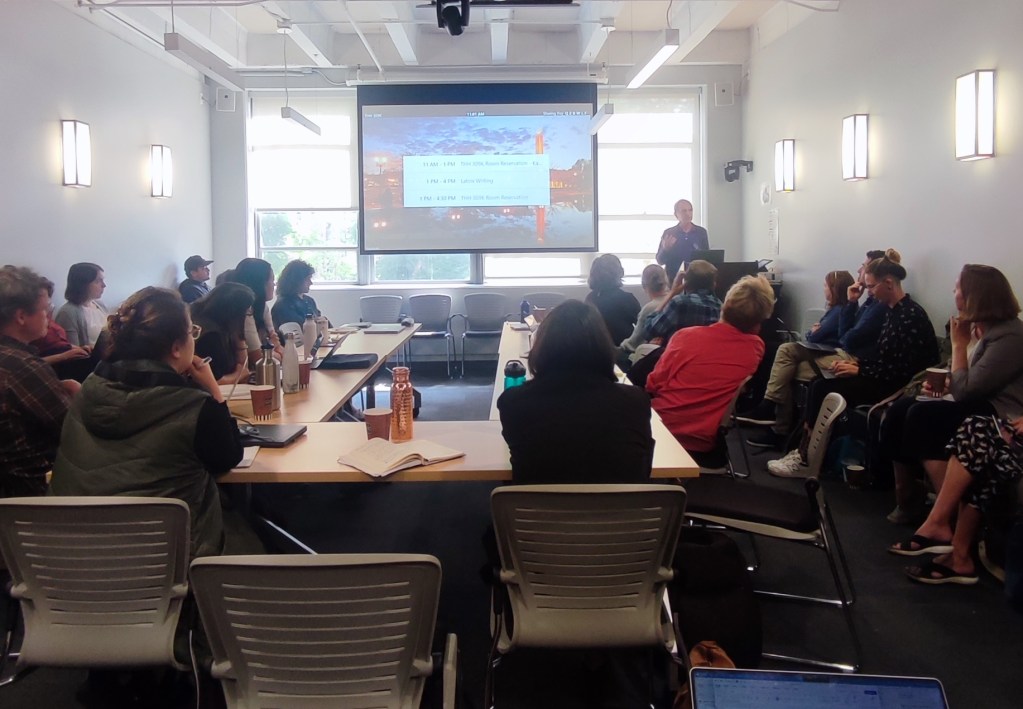
The Labyrinth Project invited us to see Los Angeles from a variety of perspectives. From the study of coyote hazing practices to energy futures, we heard from researchers who are thinking with maps, models, found documents, and collected data. These ethnographic objects help trace data politics and offer an inlet to question how knowledge is made.
Researchers from the Goethe University group, Tracing Data Politics, presented their approach to studying the political use of environmental data related to traffic, based on machine ethnography. Understanding modeling data as a knowledge-making process, the colleagues shared graphs and maps they have been working with in an effort to understand and improve infrastructure through conversation.

Expanding the Social World Downwards invited us to think through hydro-geo-social choreographies with aerial photography, map tracing, and experimental cartography. How do images from the past conjure up images of the future? We dug into questions of surveying, prospecting, and the temporality of images.
After presentations from the groups, we heard reflections from Dr. Peter Redfield (USC) and Dr. Kim Fortun (UCI). What do the data reproduce? How do diverse data resources interpellate further fields and issues? We discussed knowledge objects and the blurred boundaries between found and made in research, as well as anticipation and projecting futures.
From Emma: The conversations in and around the workshop helped me think about how I interpret the term data and its material iterations. I began to think about the possibilities of data interventions and playing with the aesthetics of bureaucratic documents. What aesthetic forms do data assume? How do these forms assert authority and could these be tinkered with? What room does this create for alternative knowledge?
In the afternoon, PhD students and young researchers from the four institutions gathered to share the problems and struggles of their research and fields. It was a chance to talk about methodological challenges, conceptual debates, and also personal circumstances that affect the research process, such as mental health.
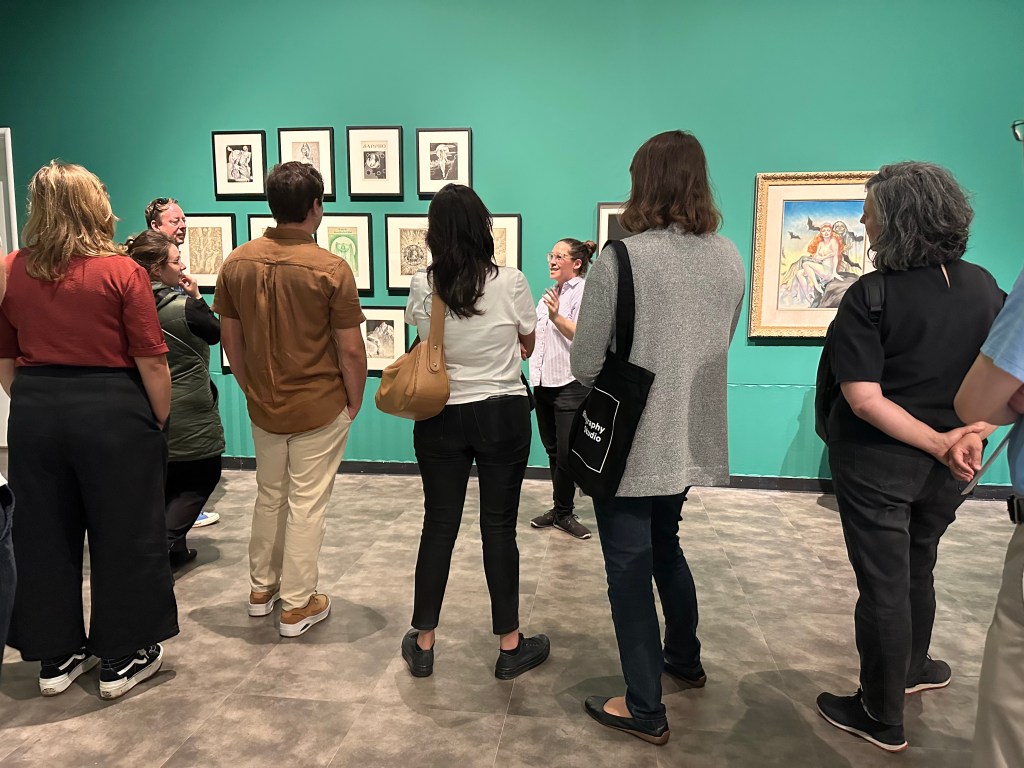
To finalize Friday’s activities, we toured the exhibition “Sci-fi, Magick, Queer L.A.: Sexual Science and the Imagination,” curated by ONE Archives and presented by the USC Fisher Museum of Art. The collection of work, from films to costumes to illustrations, considered the intersections of U.S. LGBTQ history and science fiction fandom. Artists included Kenneth Anger, Lisa Ben, and Jim Kepner, among others.
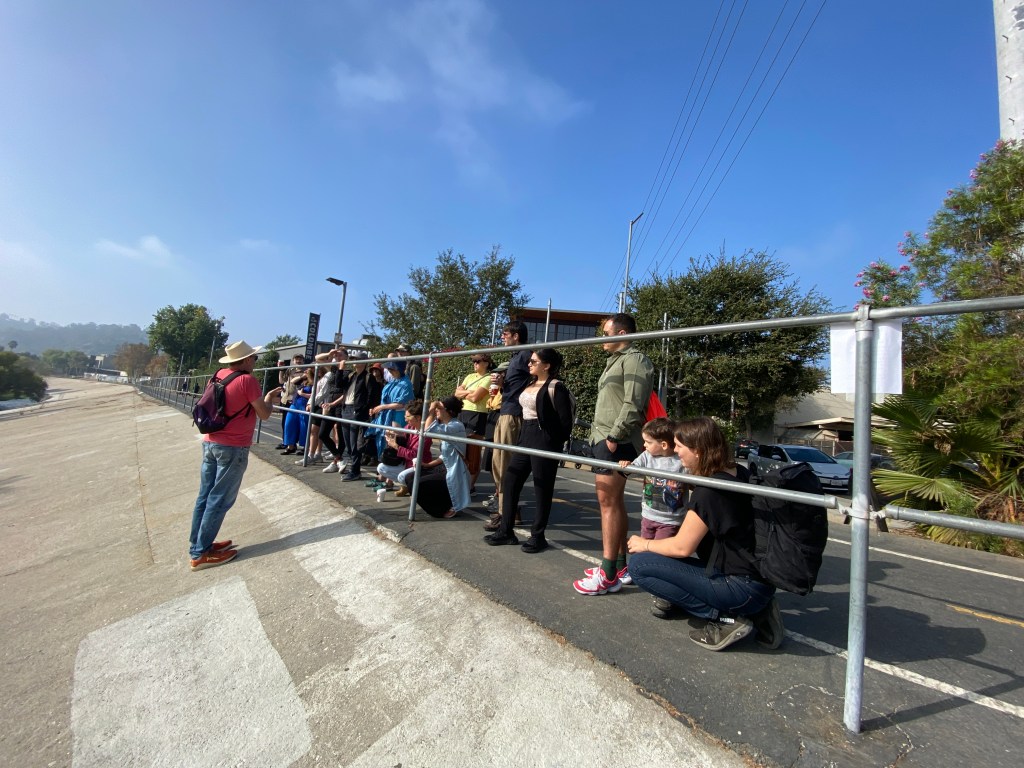
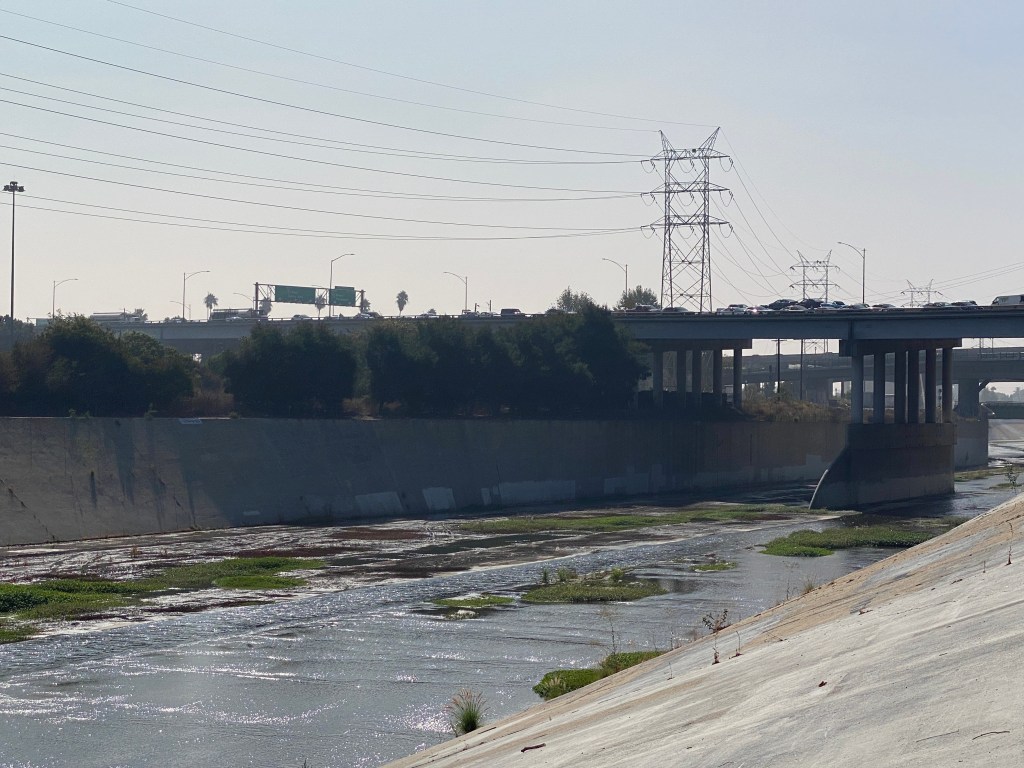
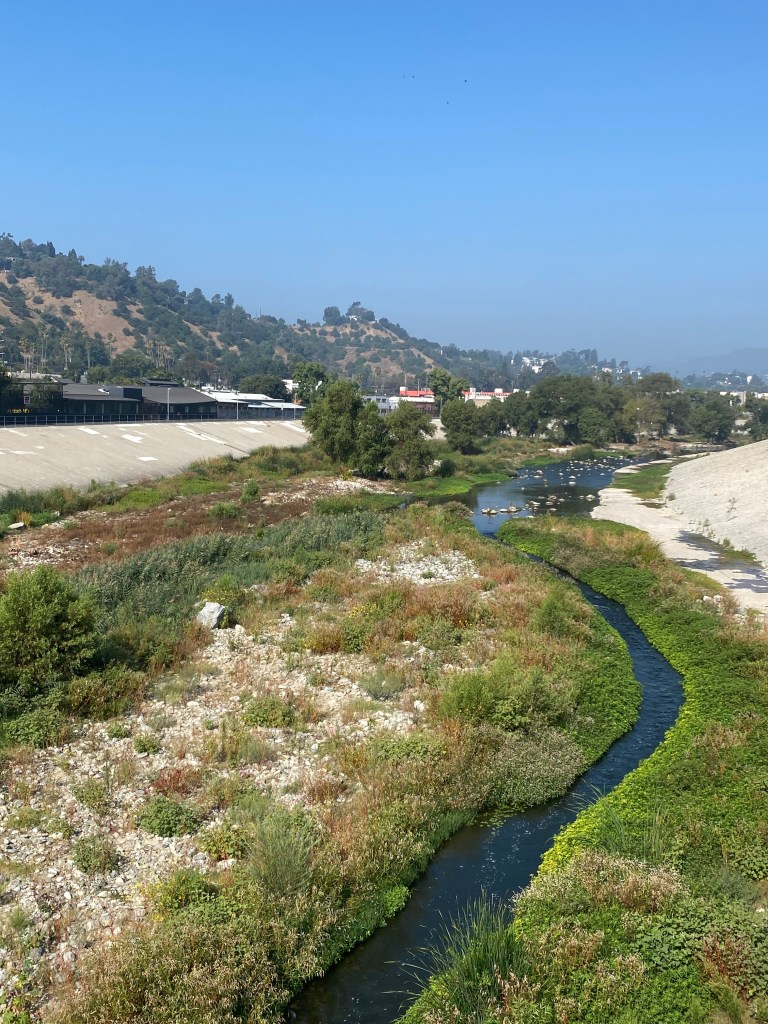
The next day, Saturday, we met at the L.A. River for a walking tour. We began at the Newell Street entrance to the L.A. River bike path, then walked along the path to Elysian park and back. Led by Dr. Chris Kelty (UCLA), we learned some history of the river, the park, and the range of species cohabiting the Los Angeles area.