Ethnography with Kin: A Conversation 2026

March 11, 2026
University of Southern California
Paige West (Columbia University)
On March 11th, we hosted a conversation with Dr. Paige West on the sustained joys and challenges of working with family. How do you work/collaborate/mobilize with people you love? What are the challenges and possibilities we face when thinking and doing are not severed from pre-existing responsibilities? How do science and knowledge take shape in this lively juncture?

Dr. West shared notes and vignettes about the daily life of years-long collaborative work with John Aini. Embedded in kinship, their work is a long-term apprenticeship that combines John’s expertise with the ecological knowledge of their Papua New Guinean family and Dr. West’s long term work in Papua New Guinea. In that context, the density of relationships between people, species, and the environment led to questions of ecological governance as a necessary passage point when thinking from within a multispecies framework. After encountering many conservation projects using methods and concepts that not only did not make sense locally but failed to yield appropriate outcomes, Dr. West and her kin asked: Can we do it better? And the answer was, we definitely can. Together they founded the PNG Institute of Biological Research and the Roviana Solwara Skul, two conservation-focused NGOs in Papua New Guinea which conducts research and trains PNG biologists and conservationists to have an impact on different policy-making levels.
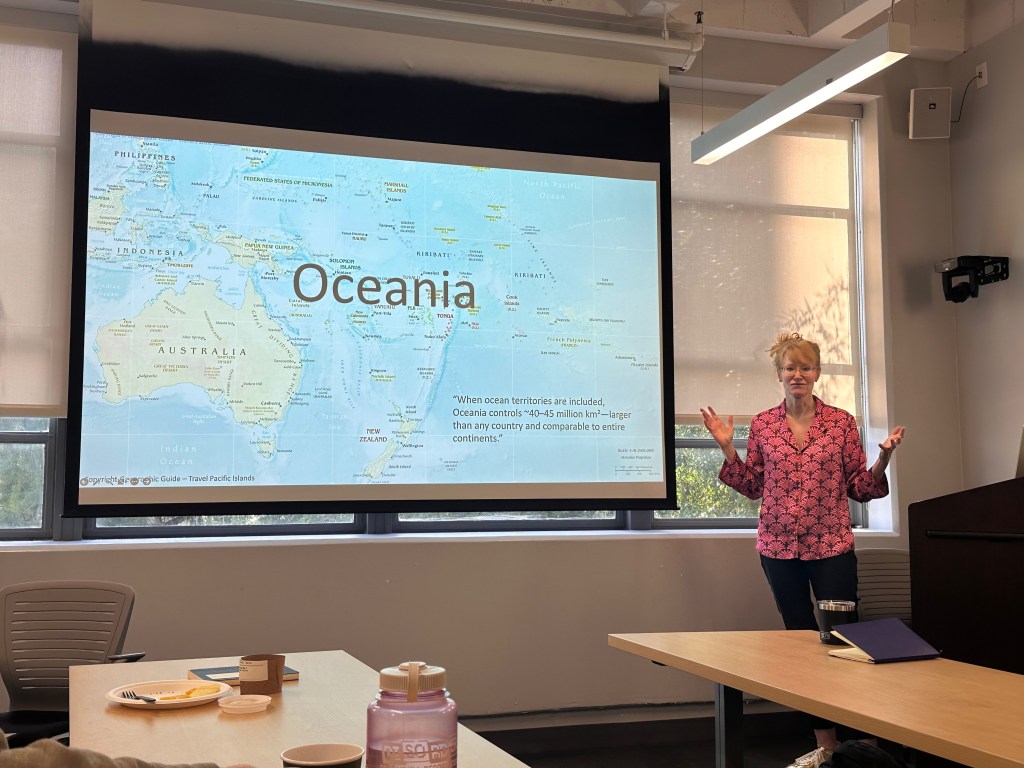
After our breakfast conversation, we joined the Anthropology Department’s Colloquium lecture by Dr. West, entitled “Kinship, Biocultural Sovereignty, and Ethical Collaboration: Reimagining Conservation in Papua New Guinea.”

The work of Dr. Paige West and her collaborators is available on her website. Their last publication, by Dr. Paige West and John Aini, was published in the Journal of Political Ecology (2026) and is titled, “Weaving the Sacred Back In: Revitalizing biocultural diversity through Indigenous-led conservation sovereignty in New Ireland, Papua New Guinea.”
Dr. Paige West is The Claire Tow Professor of Anthropology at Barnard College and Columbia University. Since the late 1990s, her research and teaching have focused on the relationships between Indigenous ecological knowledge, environmental conservation, and socio-political transformation in Oceania, particularly in Papua New Guinea, where she has conducted over 110 months of field-based research since 1997. Dr. West’s scholarship bridges the social and environmental sciences, exploring themes such as the intersections of conservation and development, Indigenous alternatives to externally imposed environmental agendas, the symbolic and material engagements with biodiversity, the commodification of ecological knowledge, and climate change. Her more recent work focuses on how ethnographic and Indigenous epistemologies can be brought into dialogue to shape new forms of socio-environmental understanding and practice. Her current research investigates sea level rise, managed retreat, and how communities adapt and forge futures in the face of climate change.She is the author of three books—Conservation is Our Government Now (2006), From Modern Production to Imagined Primitive (2012), and Dispossession and the Environment (2016)—the last of which won the 2017 Columbia University Press Distinguished Book Award.

