Shifting Matter(s), Slippery Maps: Salon 2024

March 4, 2024
University of Southern California
Shannon Mattern (University of Pennsylvania)
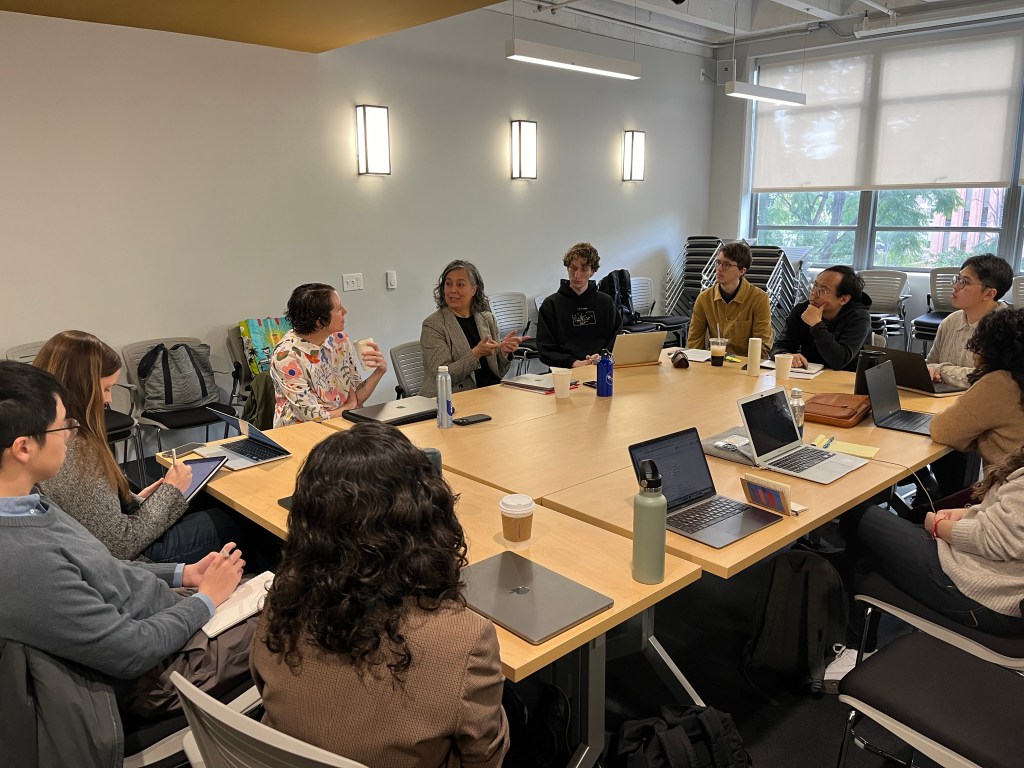
The eighth-annual Ethnographic Salon brought together students to discuss their projects through a critical mapping lens with our guest, Shannon Mattern (University of Pennsylvania). This was the first Salon opened to students beyond our home institution and we found it a great success! We were joined by students from multiple institutions in Southern California and the Bay Area, as well as students from Canada as part of our collaborative work with EMERGE. We look forward to continuing to expand the reach of Ethnography Studio in the future.
This year’s Salon theme was shifting matter(s), slipper maps. A full abstract of the Salon theme is included in our recap of the roundtable that accompanied this workshop.
After participating in two pre-workshop online sessions, students each produced a short write-up describing a “tactic” (analytic, political, material, graphic, or beyond) to deal with shifting matter through mapping practices. This tactic emerged out of students’ ethnographic research for their dissertation projects. Students also produced a map or other visual/sonic/material representation of the tactic. We discussed these tactics and maps/objects with Shannon during the March 4th workshop. A sampling of students’ work can be found below.
This year’s Salon was organized in coordination with the Center for Science, Technology and Public Life and formed part of the activities the Studio leads as part of the EMERGE collective.
Excerpts from students’ submissions
How to tell a story about a future we cannot yet imagine, but really want?
Melina Campos Ortiz (Concordia University)

Departing from Sharon Mannon’s (2017) invitation to curate ice, rocks, soils, and sediments, where she defines curating as caring for (n.p, emphasis original) and Puig’s invitation to see humans as part of the soil web–in her words “humans being soil” (Puig, 2015, p.703, original emphasis)–I wonder: what it would take to curate soil if we are set to map its relations? In a tentative attempt to reply to such a question, I present a silhouette collage as a one-data-proxy (or maybe a fake-soil-data-point) to human-soil interconnectedness that would disrupt the soil mapping knowledge mastery endeavor. I borrow the idea of working with silhouettes from a current exhibit called Fossil Fluides at the Musée d’art Contemporain de Montréal by Senegalese Canadian artist Anna Binta Diallo. This soil silhouette takes the attention away from saving the planet/saving the future narratives and instead tries to evoke potentialities grounded in a messy present when soils are contaminated and exhausted, but part of us, nonetheless. By presenting soil inside human bodies, I showcase human soil data points as a relational medium to repair ecologies in what Michele Murphy (2015) calls the “afterlife.” Read more here.
Urban Conduits: Bicycle Couriers and the Platform City
Josh Widera (USC)
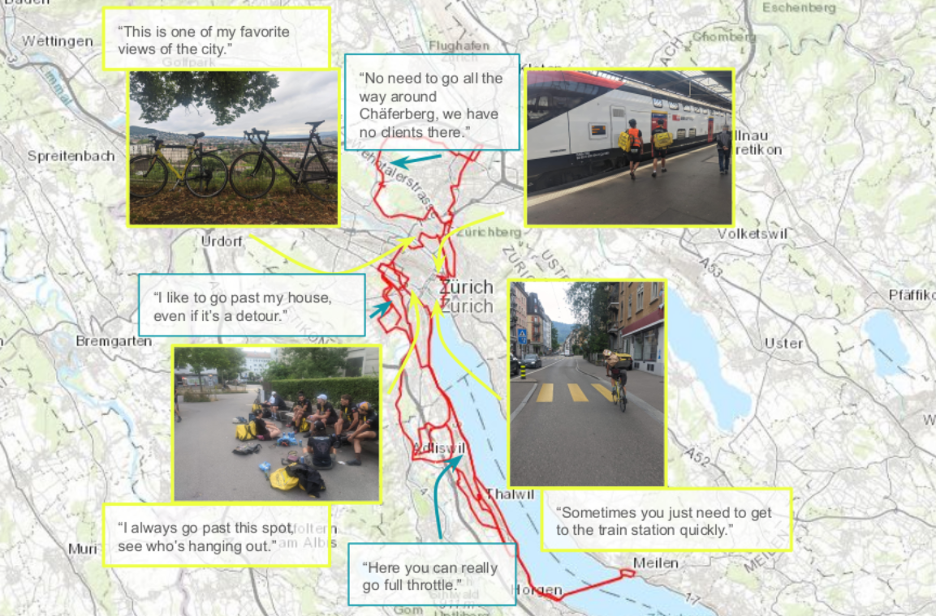
One key method I am developing to study platform urbanism and bicycle couriers are ride-alongs…. One interesting observation I keep coming across is that riders pride themselves on not using the map that is provided to them when they accept a job on their smartphone. In fact, rarely does a rider choose exactly the suggested route. When asking participants about these digressions, a few key overlapping themes arose: 1) efficiency: knowing a route the courier thinks is faster or less exhausting; 2) profitability: maximizing their paycheck for example with short cuts or by routing past “hotspots” or the addresses of big regular clients; 3) community: going past those places that are common hang-out and standby spots of their friends and colleagues or riding a section with another rider even at the cost of a detour; 4) enjoyment: picking favorite routes, either for the challenge or fun of riding for example steep hills, or fast descents, or for particular views of the city, nice buildings or parks etc. In these discrepancies riders digress from the algorithmically scaffolded working conditions to pursue their own goals which I believe play a large role in why they experience their work as meaningful and enjoyable. I am interested in these digressions in which couriers become visible as simultaneously both—a technological component of a larger infrastructure and human beings. Read more here.
The Redistribution of the Sensible
Tinghao Zhou (UC Santa Barbara)

My project on Guiyu embraces research-creation as one of its central methodologies. The polysemy of artistic practices is perfect for research on lived experiences. After my field trip to Guiyu, I began to work with artist Shengjie Dai and architect Yijun Wu attempting to create a series of artworks titled “Synesthesia (unfinished).” One piece we have been working on is “Smellscaping Guiyu,” with a modified form of smellscape mapping that tries to recreate the emergent experience of Guiyu Wei for visitors. At first glance, smells can easily defy the cartographic impulse, as they are always episodic, unstable, and emergent. However, social geographer and map historian John Brian Harley (2011) proffers a deconstructivist reading of the history of cartography and aptly reminds us of the significance of disenchantment with any cartographic claim of the sort. One of the difficulties of “representing” smells is their turbulent temporalities—the question of how to represent smells is essentially a question of how to represent temporal factors. With Harley’s critique in mind, McLean advocates that we should approach mapping not as “representative” but instead as “performative” and “artistic.” Regarding “the map as an abstract concept, and the smellscape as a moment in time,” she contends that the practice of smell mapping “no longer seeks objectivity or fixity,” but “link[s] individual users with their lived experiences of a particular place, and to consider how everyday immersion in a smellscape may feel instead of merely identifying ‘what is where’” (67). Read more here.
Mapping Comedy
Shaoyu Tang (USC)
My dissertation research project aims to investigate stand-up comedy as humorous but also political performance of storytelling in contemporary China…. Particularly in this experimental mapping project, I am thinking and experimenting about how the idea and theories of mapping could help me analyzing a special form of data—advertising articles for comedians’ comedy specials written by themselves. These are very common and wide-spread public archives among Chinese stand-up world. They are the most crucial channel from which audiences can know the comedy special and buy tickets. In other words, these “advertisements” should have shown how funny the show would be. Yet, a close reading of these articles reveals that, except for a few words talking about laughter, almost the whole article (in most cases) is written in a very poetic tone and is about the comedian him/herself (rather than about how funny the show is). Such a unique genre of writing that is not only closely related to comedians’ career, but a platform for comedians to voice for themselves seriously (contrasting to merely making jokes on stage) is worth examining. As comedy studies are commonly about researching “interactions” between audiences and comedians, this project asks what if we study “comedy/comedian” without using any joke analysis? What do comedians see their worlds that are created by themselves but at the same time are results of the negotiations between comedians and their prospective audiences. Read more here.
Mapping Absence: Excavating Migrant Narratives through Speculative Fabulation
Paulina Lanz (USC)
My dissertation examines contemporary art focused on the US-Mexico borderlands, analyzing how artists convey marginalized migrant perspectives obscured in dominant political discourse and national mythmaking. A key tactic I deploy is “mapping absence” – identifying narratives suppressed and lives erased in official accounts of borderlands expansion, from settler colonialism to infrastructure projects like the border wall. I excavate occluded stories through practices of speculative fabulation, inspired by Saidiya Hartman’s writing and the film A Love Song for Latasha. … I adopt critical and speculative fabulation to imagine unknown migrant viewpoints and experiences elided in dominant narratives glorifying border expansion. These fabulations make space for life stories from material residues of their journeys, like artifacts in the Sonoran desert that are either unrecognized or rendered as trash. For instance, Richard Misrach’s photograph Migrant blanket, Douglas, Arizona, 2009, depicting a discarded, dirt-stained blanket in the Sonoran desert, conjures an unknown border crosser whose perilous journey and identity remain invisible. I critically fabulate a possible life story behind this material residue of unrecorded passage, in a similar way as Allison resists “extraction” of black pain in reconstructing Latasha’s presence; I avoid appropriating migrant’s experiences. Instead, creatively highlighting absence underscpres their silencing and my methodology’s limits. In its turn, this excavates realities absent from anti-immigrant rhetoric about the documentality of migrants, as through imaginative reconstruction suppressed narratives can be reasserted against erasure. Read more here.
Shifting Experience
Ziwei Chen (UC Berkeley)
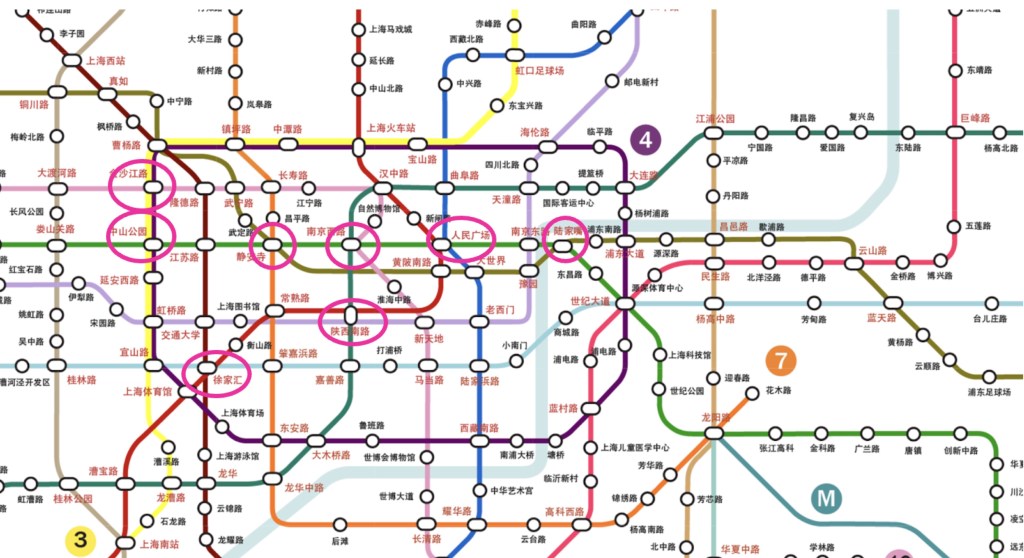
My tactic of registering the shifting and seemingly immaterial urban experience is through deep mapping and archaeology of the experience of the urban interior. My archival interests aside, [above] is a map of the Shanghai metro in the city center. Each subway line is marked in a different color, and their intersecting points are transfer stations. What I have circled in pink are major railway transfer hubs, where the interior is meticulously designed and linked with commercial sites such as shopping malls and office buildings. In other words, these railway and commercial hubs become nodal points in a network of both the movement of trains and the urban sensory experience. They can be seen as literal hubs and centers of information processing that produce and reorganize the sensory perception. Read more here.
Heart Transplant Affects
Joel Ferrall (USC)

I will be using the patient’s 3D MRI scan post-transplantation as cartographic material to analyze both the granular and general emotional journey of an individual traversing transplantation. I imagine a data collection that is a combination of patient self-report as well as ethnographic witnessing and an unlimited amount of variation or combination in defining emotion, allowing for hourly variation. Using the image of the stitched-in-place donor heart as cartographic material simultaneously highlights the heart as a powerful and general affective symbol while also subverting the heart and the biological purity of the image of the organ. The suturing of the donor heart into place, the physical anchors through which anastomoses occur, also symbolize for me the ways in which connections to the medical institution and its (sometimes) abstracted actors, interact with one’s affect in a mutually transformative way. This is a political component of the tactic, determining which actors (or objects?) to include in these anastomoses will inform our analysis while hiding other aspects that are excluded. Read more here and see accompanying mapping images here.
Mapping Colonial Waterscapes in Mexico
Jéssica Malinalli Coyotecatl Contreras (UCSB)

What socio-environmental landscape an energy transition megaproject conjures? In Central Mexico, the Morelos Integral Project is part of the country’s international commitments for carbon reduction, by producing electricity from natural gas. The government and the transnational companies involved in its construction and operations insist that the project is contained in its sourcing pipeline, power station, and electric cables, and a 500 mts radio (0.3 miles) around this infrastructure; the Mexican authorities have mark it as an issue of public interest and have deployed the state forces to assure its completion, signaling as part of the country’s move into the future. … My ‘shifting matter’ is how to decentralize the perspective on the recognized infrastructure (especially the power plant) to include this much deeper history in which waters are central to lives and experiences. While I recognize and I am guided by the ‘big markers’ (like the project itself and the demonstrations and protests), I want to bring to light the conflict and the struggles people are immersed in as result of this big scale transformations. Therefore, I turn to a location that is far from the center of the controversies, where none of the recognized part of the infrastructure and center the voices of people that are not covered by the lights of the press. I pay attention to how people describe their relationship to the water that is left by the process of the thermoelectric plant to explore the production a different landscape. Read more here.
Mapping the Survival of Small Farms in the San Joaquin Valley
Margaret Tebbe (UC Irvine)
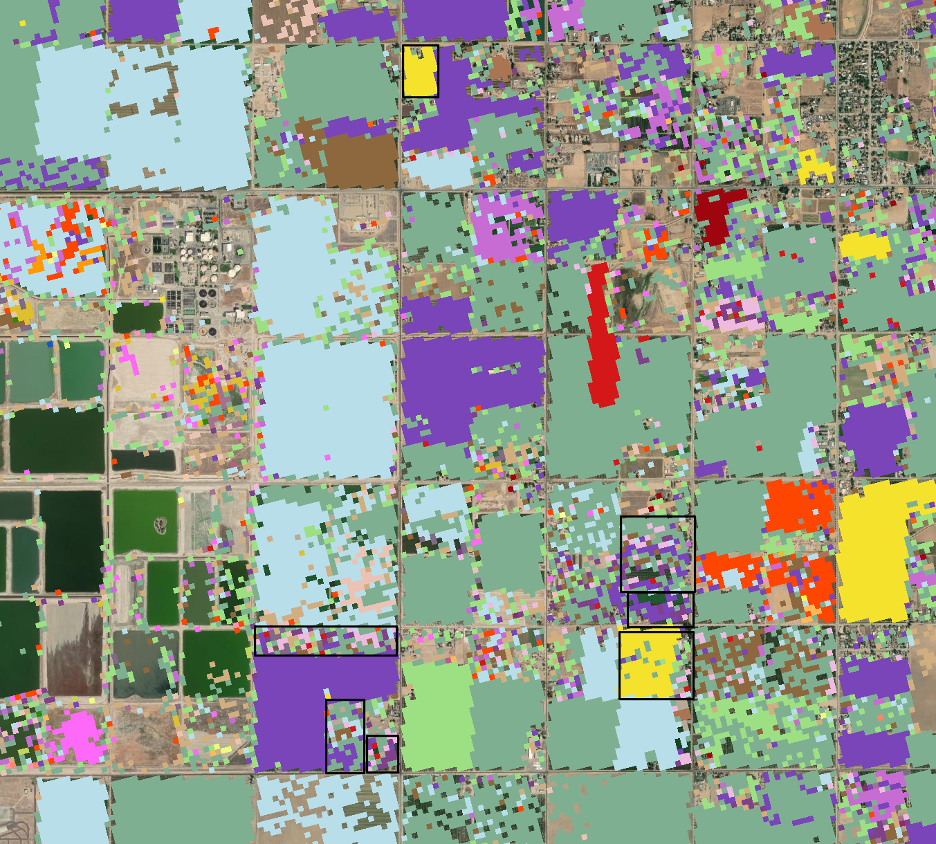
Following Mattern’s (2022) call to move beyond documenting disappearance, I want to recognize that although the total acreage farmed in the San Joaquin Valley is dominated by a handful of very large farms (including most notably the Wonderful Company and the J.G. Boswell Company), more than three-fourths (25,000) of the Valley’s farms today are less than 100 acres. Many of these are specialty farms that focus on a few crops, sometimes grown with organic or water-wise practices. Some farms experiment with different crops or varieties of crops that are better suited to the Valley’s changing climate. These are the farms that we must look to in order to prevent the transformation of the Valley into “successively smaller, isolated pieces of land that capital proclaims are no longer culturally significant or agriculturally feasible” (Mattern, 2022, p. 13). I would like to propose a mapping tactic that helps foreground these small farms as a presence that has remained somewhat stable in the Valley, even as the world shifts around them, and that presents a stable path forward into an uncertain future. I write stable here not in the sense of farms that have retained the same owners or boundaries for a century, but in the sense of farms that have resisted the trends of accumulation and conglomeration into the agribusinesses that have dominated the Valley. Fully realizing this tactic would require extensive analysis and access to paywalled data that is currently beyond my means and, though it is something I want to explore in the future, for now I will respond to the provocation from our last meeting to put aside the desire for infinite data and imagine how to map a single data point. Read more here.
Conjuring Buffalo in the “Queen City”
Savannah Kosteniuk (University of British Columbia)
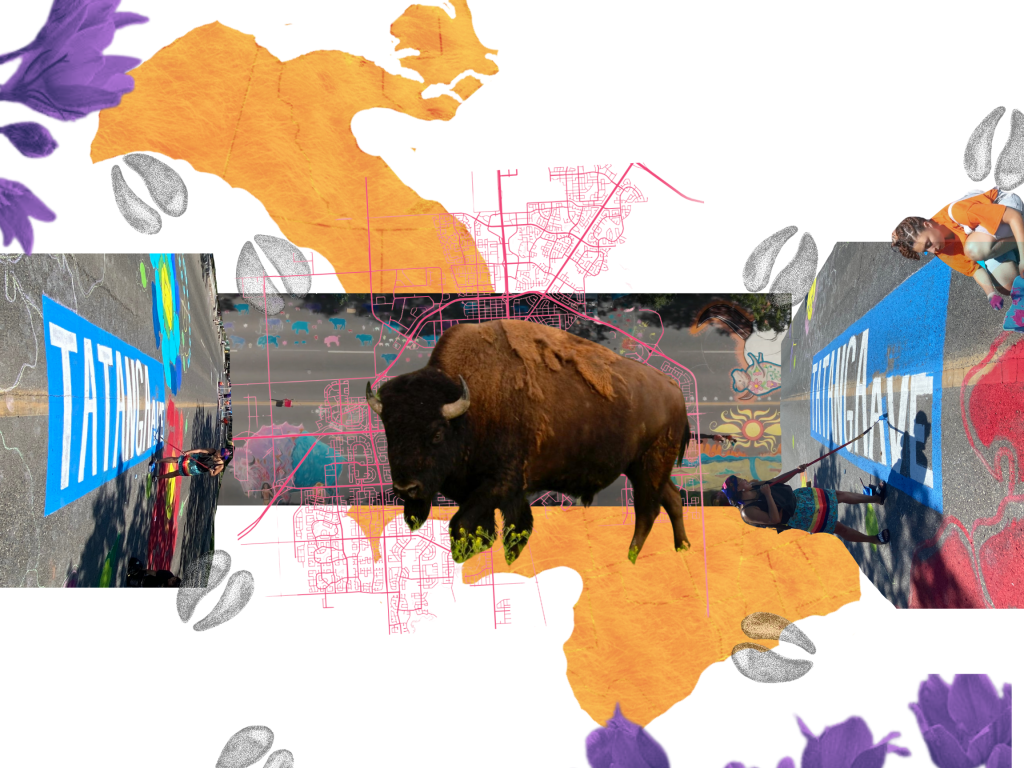
In response to the Salon’s focus on “shifting matter” I wanted to think about the transformation of the topography and toponymy of the prairie landscape, imposed through colonialism and its urban infrastructures, as well as the spatial acts that attempt to resist and re-presence the buffalo on the prairies. Building on the artistic and communal spatial acts occurring during previous Buffalo Days, I wanted to bring the buffalo into the “Queen City” and on Dewdney Avenue and to map the ways the buffalo has been conjured by community members over time. I played with this idea through layering different images and abstracting maps. I took a map of the precolonial geographic range of the buffalo and imposed a grassy (almost- hairlike) texture on it to presence buffalo territory and its relationship to (or as?) Land as a keystone species. I used images from previous Buffalo Days, including a birds-eye-view of the street with the completed murals as well as photographs I took at street level, combining the views from different years to compose the central road, Dewdney Avenue. The different angles of the road are put together to expand and disrupt normative orientations of space. The images used on the “edges” are pictures I took of artist Brianna LaPlante’s mural, which reads “Tatanga Avenue” (Buffalo Avenue). I took a map of Regina and then reoriented it to mimic the shape of the central buffalo figure. From the center, buffalo hooves move outwards, indicating historical and ongoing presence. Prairie crocuses, a plant related to the buffalo, have also been added to the creation of space that transcends urban settler time. Through layering the historic presence of buffalo, in and beyond urban space, with the spatialized community acts that activate the buffalo in the present cityscape and contested road, this experimental map hopes to contribute to the larger project of conjuring buffalo in the present and imagining futures otherwise. Read more here.
